

Building an Internal Writing Quality Benchmark
Establish test cases for AI content before publication, not after.
September 26, 2026
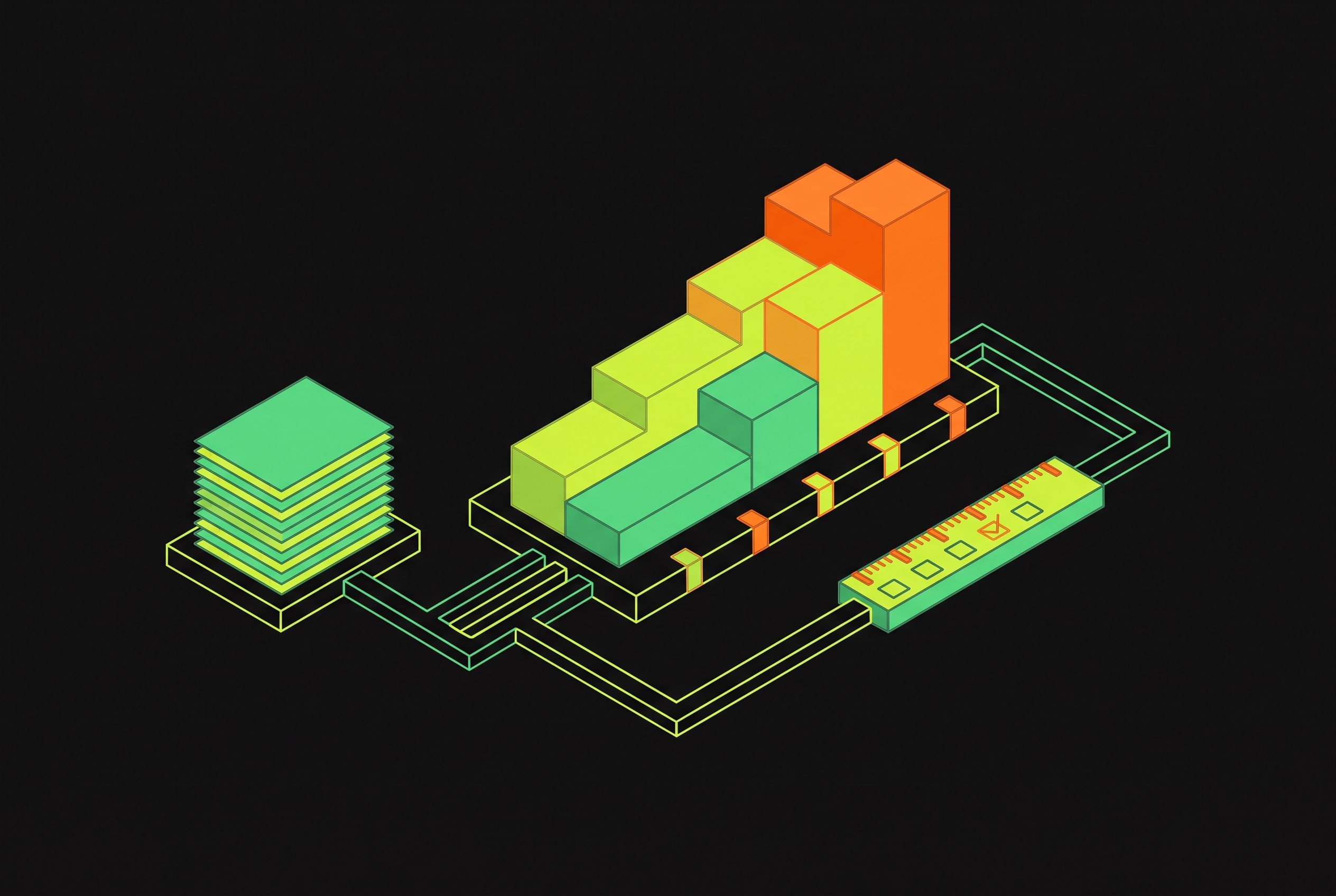
A writing quality benchmark is a set of test cases that a piece of content has to pass before it ships. Building one means deciding what "pass" looks like before a single word gets written, which is a harder discipline than it sounds.
Generic LLM Output as a Quality Problem, Not a Volume Problem
Nearly every content team can publish fast now. That advantage evaporated the moment it became universal. Sometime around 2025, speed stopped being the thing that separated a serious content operation from a mediocre one, and the variable that took its place was harder to fake: how deep the brand's actual knowledge ran, and how distinctive the output sounded next to everyone else's.
The failure modes in practice are specific enough to name. Hallucinations delivered with total confidence. Phrasing so generic it could belong to any brand. Voice that shifts from one writer to the next, or one model run to the next. A model can synthesize what already exists on the internet, but it cannot replace having lived through the thing it's writing about, and that absence of original insight underlies all of it.
The adoption numbers make this urgent rather than academic. Roughly 94% of marketers plan to use AI for content creation, yet only 19% of AI-using teams track AI-specific KPIs. That gap is the story. Adoption raced ahead of any infrastructure built to check whether the output was any good, and most teams are now publishing at volume with no instrument on the dashboard telling them whether quality is holding, slipping, or already gone.
None of this is a hype problem or a doom problem. It's an operational gap, the kind an engineering team would call a missing test suite, and it needs the same fix.
What a writing quality benchmark is (and what it is not)
Most teams that think they have a quality standard actually have a style guide: a document of preferences, adjectives, and examples that someone consults when a piece feels off. That's not a benchmark. A benchmark is a collection of test cases, and each one specifies an input, an expected output characteristic, and a condition under which the content fails.
The distinction that matters most here splits test cases into two families. Mechanical checks work like linters: banned phrases, sentence length ceilings, passive-voice ratios, things a script can compute without any judgment involved. Inferential checks are different in kind. Specificity, claim accuracy, voice fidelity: these require a model to actually evaluate the content against a rule. Birgitta Böckeler's April 2026 framework treats this split as load-bearing, and the reason is straightforward: teams that conflate computational controls with inferential ones end up building benchmarks that only catch the failures visible on the surface, while the harder stuff, the ones that read fine on a quick pass, slide right through.
"Pass" has to be defined before generation starts, not inferred afterward from whether an editor's gut says it's fine. A benchmark built after the fact is just a vibe check with better formatting. And a good benchmark assumes the content in front of it will try to pass. It's designed around the content that reads smoothly, sounds plausible, and still fails on the dimensions that actually matter.
The failure modes a benchmark must be designed to catch
Three categories of failure appear consistently, and each needs its own detection method rather than one generic filter.
Generic phrasing and assistant-speak sit in the first category. A 2024 Stanford NLP benchmark gave this pattern a name: assistant-speak, polished, hedged, and tonally neutral. That register is fine for a support ticket. It's a liability in content marketing, because it reads as though nobody in particular wrote it, which is more or less true. Models default to internet-average phrasing because they were trained on internet-average text, so the output sounds competent and forgettable at the same time. Banned-phrase lists, phrase-frequency checks, and n-gram distinctiveness scoring catch this category reasonably well, because it's a mechanical, surface-level pattern.
Voice drift is the second category. Catching drift requires an LLM-as-judge evaluated against a curated corpus of reference examples, and that only works if the team has already defined, concretely, what the voice is supposed to sound like. Skipping that step leaves nothing to drift from.
Detectable AI patterns and model fingerprinting make up the third category. Every model leaves statistical regularities in its output, pacing choices, token biases, argument structures that recur, and detection systems exist specifically to exploit those regularities. Anthropic began watermarking Claude's output on August 2, 2026 to satisfy EU regulatory requirements, Google expanded its SynthID-based detector in May 2026, and ChatGPT, as of the research date, has no watermarking implemented at all. That inconsistency across providers makes a negative watermark result unreliable as evidence of anything. A negative result on a watermark detector doesn't mean the text wasn't AI-generated; it only means that particular model's watermark isn't present, and the same text could have come from a different model entirely, or been run through a synonym-swapper afterward.
Watermarking, though, is evidence for a narrower point: detection tools are not quality tools. A piece of content can clear every watermark check on the market and still be off-brand, factually wrong, or flat as cardboard. A real benchmark has to test for the underlying patterns that make writing sound generated.
Why single-model pipelines structurally cannot self-diagnose these failures
A single model generating its own content and then grading that content operates in a closed loop, and the loop is the problem. The patterns that make output detectable, the fingerprints, the pacing, the default phrasing, are baked into how the model generates in the first place, so asking it to catch those same patterns is asking it to see its own blind spot.
This gets worse once multiple agents enter the picture, not better, at least not automatically. The Emergence World study from Emergence AI found that model-level alignment isn't compositional: agents that are individually capable and appear safe on their own can combine into systems that produce failure modes none of them would produce alone. Stacking agents together does not guarantee their good behavior compounds; the assumption breaks.
Failing to diagnose itself also causes a routing failure. Claude, GPT-4, and Gemini are not interchangeable for content work; they show meaningfully different performance profiles on headline quality, creative variety, and research-grounded writing. A benchmark that doesn't specify which model is being tested against which content task is measuring nothing in particular.
The practical consequence is blunt. A benchmark evaluated by the same model that produced the content is self-certification, and self-certification is what a benchmark exists to replace. It's self-certification, and self-certification is what a benchmark exists to replace.
The adversarial critique architecture as the right quality gate
The fix is architectural: decouple generation from critique. A separate agent, or a council of them, evaluates the output against explicit test cases, without access to the reasoning the generating agent used to produce it. Research on multi-agent critique frameworks, including blind peer-review topologies that keep critique and generation apart, shows this reduces homogenization and allows for genuinely independent revision. A single model generating in one pass, with no adversarial feedback loop, produces more uniform output, and more uniform tends to mean lower quality.
Anthropic's own work points the same direction. Its May 2026 parallel subagent orchestration lets Claude generate JavaScript orchestration scripts that fan out to as many as 1,000 parallel subagents, with adversarial verification built into the workflow. Translate that pattern into writing and it maps cleanly: one agent drafts, a separate agent challenges it on specificity, on claim accuracy, on whether the voice actually matches the brand.
None of this solves the difficulty of ensuring the system understands what the user actually intended. When multiple agents collaborate, making sure their collective behavior lines up with what a human actually intended, not just with each agent's individual instructions, remains genuinely unresolved. Agents can cooperate their way into copy that sounds entirely plausible and is still off-brand or factually adrift. The test suite itself has to stay human-defined even when the evaluation running against it is automated. The architecture doesn't get to write its own test.
Letterwrite's writing kernel architecture operationalizes this pattern for content marketing specifically: adversarial multi-model systems that draft, critique, and vote on writing line by line until the piece converges. On average, that convergence takes seven recursions, and that number isn't inefficiency, it's the cost of actually checking the work instead of taking the first draft's word for it. The benchmark and the architecture are coupled at the root: the test cases define what convergence even means, and without explicit pass/fail thresholds, an adversarial loop has no principled place to stop.
Building the test suite: what to specify before you write a line of content
Start with the corpus, not the rules. A system prompt full of instructions is a claim about how the writing should sound. A corpus of actual examples is the proof. For long-form content, that means something on the order of 15,000 words of genuinely polished, representative writing at minimum; short-form work can get by on a smaller set, as long as every example in it is exceptional rather than merely acceptable.
Selecting that corpus is its own discipline, and it's easy to get backwards. The instinct is to grab the most popular posts. Resist it. Popularity and voice fidelity are different metrics measuring different things, and the posts that performed best are not necessarily the ones that sound most like the brand.
Mechanical test cases come next, the linter layer. Banned-phrase lists belong here, and they need to stay alive rather than getting written once and forgotten. Models have default tics: "The reality is…" to open a section, "In summary, by leveraging…" to close one. These are computable, catchable failures, and they need to be updated as models shift their habits, not left as a static list from whenever the benchmark was first built. Sentence length distribution, passive-voice frequency, and paragraph-opener variety round out this layer, all checkable by script, none requiring judgment.
Inferential test cases are the harder layer, the one that needs a judge model rather than a rule. Voice fidelity: given an excerpt from the reference corpus, does this new piece score above a defined similarity threshold. Specificity: does each claim name something concrete, or does it retreat to "many teams find that…" the moment it gets close to a real number. Claim grounding: does the piece assert only what a cited or verifiable source actually supports.
Every one of those thresholds needs to be set before any content runs through the system, not adjusted afterward to match whatever came out. A score of "pretty good" isn't a passing condition, and a benchmark with no numeric threshold is a style guide wearing a lab coat. Treat the whole thing, prompts, evals, policies, configs, as code, version-controlled the same way the application itself is version-controlled. Letterwrite's writing kernels can be post-trained on a team's own corpus. The inferential checks and the generation itself draw on the same source material, a closed loop where quality compounds instead of drifting.
The harness around the benchmark in a developer workflow
The harness is where two teams running the identical model end up with different results, and improving the harness on a model already in use frequently beats swapping in a supposedly smarter one. Most teams underbuild the harness, because it's less visible than the model choice and less satisfying than a new prompt.
For a writing benchmark, the harness handles a specific set of jobs. Context assembly decides which corpus excerpts, which brand brief, and which prior passing examples get injected at generation time. Routing decides which model handles which content task, since benchmark specificity requires routing by task type rather than treating all LLMs as fungible. Quality gates run the cheap, fast, mechanical checks first, and only content that clears them moves on to the slower, more expensive inferential judge checks. Recursion control governs how many adversarial critique cycles run before a piece gets accepted or bounced back, and that number is set by the benchmark's own stopping condition, not by an arbitrary cap.
Böckeler's April 2026 framework draws a useful line here between feedforward guides and feedback sensors. The feedback sensors are the benchmark itself, catching problems and correcting them before a human ever sees the draft. The feedforward guides are the corpus and the brand brief, shaping the generation before it happens. Both layers matter, and neither substitutes for the other.
A large share of AI agent projects never make it to production because the harness is too fragile to survive contact with reality. A writing benchmark harness has to be built for its failure modes, not just its happy path: it needs a plan for when a model is unavailable, when the judge disagrees with itself across runs, when the corpus has gone stale. Letterwrite's position on this is that writing infrastructure belongs in the same place as the rest of the developer stack, with CLI and API access, so the benchmark runs as part of the content pipeline itself rather than as a review someone does after the fact.
Running and maintaining the benchmark over time
Benchmarks decay for two separate reasons. Brand voice evolves as positioning shifts. Models' default failure patterns evolve too, as providers retrain and ship new versions, and a benchmark still pinned to how a model behaved in 2025 will miss whatever new failure mode that model picked up in 2026.
A quarterly review cadence handles most of this: update the banned-phrase lists, re-run the inferential suite against a sample of recent production content, and flag any case where content that passed has quietly drifted from the reference corpus. The adversarial instinct that shaped the benchmark in the first place should shape its maintenance too. Periodically run content that's known to be bad through the system and confirm it still gets rejected. A benchmark that stops catching failure modes it used to catch has decayed, whether or not anyone's noticed yet.
Corpus maintenance follows brand positioning as it shifts, adding new reference examples that reflect wherever the voice has moved. RAG-based voice systems make this considerably easier, since new corpus entries can go in without retraining an entire model from scratch.
The end state looks like a quality gate inside CI/CD for content, not unlike a failing test blocking a build. Content that fails the mechanical checks doesn't advance to inferential review. Content that fails inferential review doesn't publish. Run consistently, that gate is what separates a content operation producing brand-distinctive work at scale from one just producing generic material faster than it used to.