

Why Single-Model Output Is Structurally Detectable
Statistical fingerprints in AI output survive attempts to hide them.
September 30, 2026
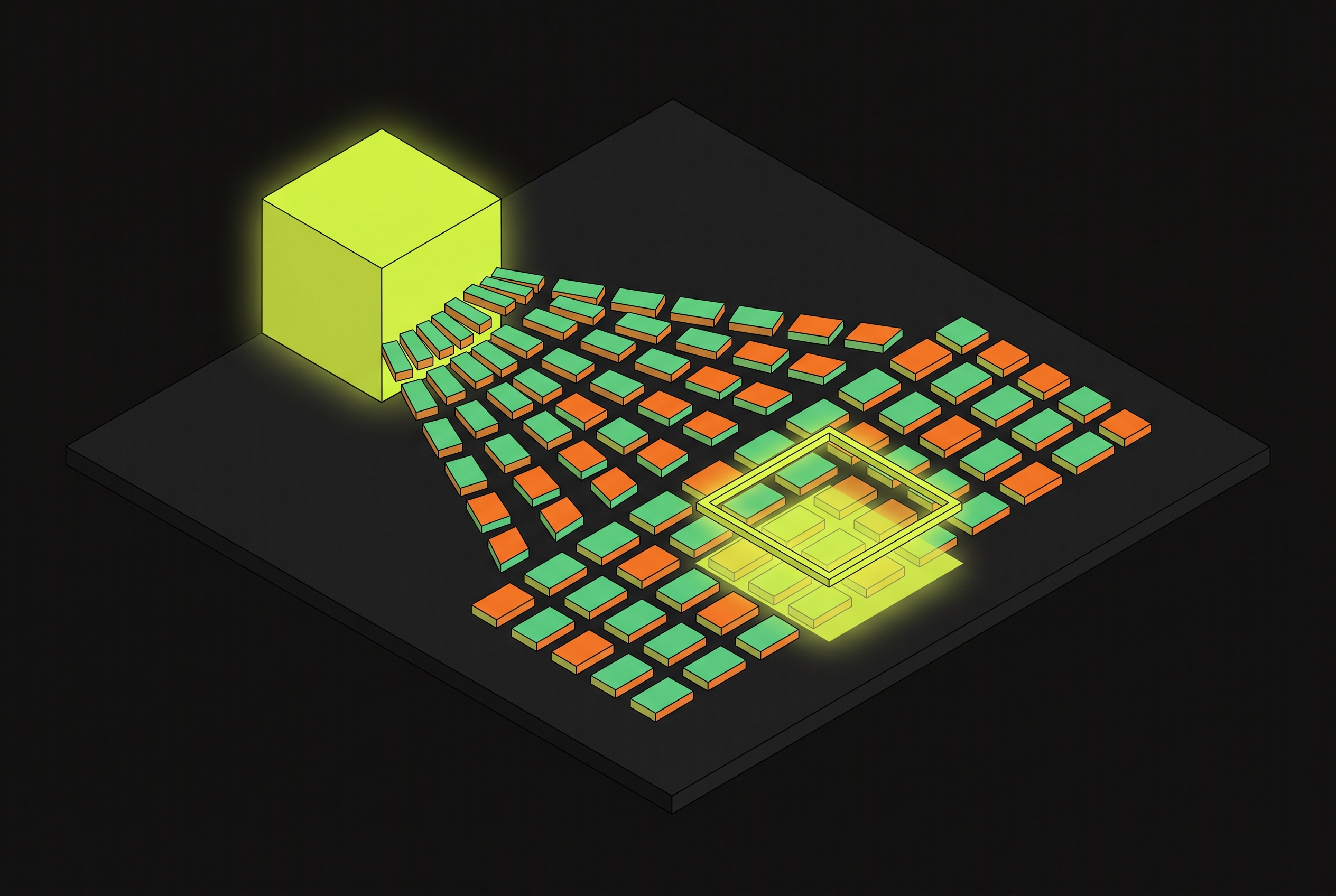
Single-model AI output is structurally detectable for reasons that have nothing to do with how the writing reads on the page. It comes down to statistics: a model's probability patterns, perplexity curve, and sentence-length rhythm compound across a body of text into a signal no prompting fully erases. Perplexity measures how predictable each word is to the model that generated it, and burstiness measures how much sentence length and structure vary across a piece. Both stay stable as fingerprints even as newer models get better at faking human writing's natural irregularity.
Stylometry sits on top of that probabilistic layer as a second, independent form of attribution. Average word length, sentence complexity, punctuation habits, and grammar patterns are measurable traits; text that keeps opening with "Furthermore" while avoiding contractions gets flagged because those habits are statistically stable across a model's output. The tell is a measurement, not a vibe. It's a measurement.
Volume is what turns a subtle statistical tendency into an unmistakable signature. A single sample carries a weak signal, easy to dismiss as noise. But when one model produces dozens or hundreds of pieces, the same regularities recur, and a homogeneous corpus becomes easy to attribute back to its source.
This is why detection vendors don't build one classifier and call it done. CudekAI, for instance, runs adaptive fingerprint analysis tuned separately to each model it covers, including GPT-5.5, Claude Sonnet 4, DeepSeek V4, Grok 4, and Llama. A shared classifier across all of them would blur the signal, since each model writes with its own habits and quirks. Any team leaning on a single provider faces an uncomfortable practical upshot: routing all of your output through one model doesn't reduce your exposure. It maximizes it.
Detector recognition of model-specific patterns, not just AI in general
Detectors aren't static AI-versus-human classifiers waiting to be outsmarted once. They're trained per model, updated on a regular cycle, and built specifically to counter the evasion moves that single-model producers actually try.
The technical foundation is perplexity: tokens in an LLM's own output look more "expected" to that LLM than human text does, since it's scoring its own likely continuations. Binoculars pushes this further by comparing cross-perplexity between two different LLMs at once, a method that traces to Hans et al.'s 2024 research.
Turnitin's release history shows what "continuously updated" actually looks like in practice. Model updates landed in April 2025, August 2025, October 2025, and February 2026, each improving recall while keeping false positives low, with the August 2025 update specifically adding detection for humanizer-disguised text. That's a company treating detection as an ongoing engineering commitment. That's a product roadmap built around an adversary who keeps moving.
And Turnitin isn't operating alone. GPTZero, Pangram, Originality, Copyleaks, and Sapling each have different accuracy profiles, but together they ensure any sizable single-model corpus will cross paths with a classifier tuned to catch its source.
The deeper problem for anyone hoping to stay anonymous is that fingerprinting doesn't stop at the text. Forensic audit research from Yisen Xi shows model identity can be reconstructed from black-box API access alone, via configuration fingerprinting, tokenizer differentials, and behavioral probes. Out of ten known-identity stealth releases tested, the protocol landed seven exact identifications. Even a model deployed anonymously isn't reliably opaque. A related finding in the same paper shows a large share of fingerprint checks failed outright on shadow APIs, so a vendor's advertised model identity can't be trusted even when named in documentation (a supply-chain risk layered atop the attribution issue). Deep learning classifiers, including RoBERTa-based models and successors, train on known human and AI corpora to distinguish text at the distributional rather than surface level.
Failure of prompt engineering and humanizer tools against a structural problem
Prompting your way past detection, or paraphrasing output afterward, treats the problem as cosmetic. Treating the problem as cosmetic misreads what it is. Detectability lives in the distribution, not on the surface, and surface-level fixes don't touch it.
The SHADE framework results make this concrete in an uncomfortable way. Full fine-tuning with a small KL regularization penalty pushes evasion rates against a surrogate detector well above a base model's. But linguistic analysis of that evasion shows the output got shorter, simpler, and less lexically varied to achieve it. In other words, the fine-tuned model didn't get better at sounding human. It got worse at writing, and that's the price of the evasion. One fine-tuned model beating one surrogate detector is a narrow, temporary win. It's a trade of quality for a temporary win against a specific target.
AI humanizer tools run the same experiment at the practitioner level: paraphrase AI-written text through dedicated software, hoping it reads human enough to slip past a detector. Pangram Labs' DAMAGE paper studied nineteen such tools and found many existing detectors do fail against humanized output. But Turnitin's August 2025 update closed that gap, now flagging likely use of bypasser tools directly. Whatever advantage humanizing offered had a shelf life, and that shelf life was measured in one vendor update cycle.
The University of Technology Sydney's entry in the ELOQUENT 2026 Voight-Kampff competition, by Galat and Rizoiu, states this asymmetry precisely. Pushing generated text out of a detector's training distribution reliably beats adversarial detection. Pulling text into the distribution, by mimicking human training data more closely, fails completely. Evasion recipes that looked clever in 2025 collapsed to near-zero success once detectors retrained on them. Even the obvious patch, augmenting training data with older, period-style prose to close a historical-register attack, backfired: the UTS paper reports it made that attack slightly more effective, not less. Whoever is fine-tuning a single model to dodge today's detector is, by definition, one step behind the detector builder's next move.
There's a further wrinkle for anyone assuming fine-tuning simply scrubs a model's fingerprints. ICLR 2026 research on semantically conditioned watermarks (arXiv:2505.16723) introduced a watermarking method surviving fine-tuning, quantization, pruning, and sampling changes, holding up where earlier methods relying on fixed query-response pairs fell apart. That result is domain-conditioned and shouldn't be read as a universal guarantee against every future evasion technique. But it does close off the comfortable assumption that a quick fine-tune pass is enough to make a model's origins untraceable.
What multi-model architectures do differently at the distributional level
If surface fixes fail because they're operating at the wrong layer, the alternative has to operate at the right one. Multi-model architectures don't try to disguise one model's output. They route generation across a joint distribution no single detector's training set was built to capture. That's the same out-of-distribution asymmetry the UTS evasion research surfaced, now applied as a design principle rather than an attack. A classifier trained on individual models' outputs has no training signal for what a joint distribution across several models looks like, so it fails to catch it.
The clearest empirical evidence for this comes from a September 2026 arXiv paper (arXiv:2609.31876). It describes Claude Opus 5 operating inside a Claude Code harness, orchestrating a local base model and drawing most output tokens from that base model rather than from Opus itself. That setup cuts detection structurally rather than marginally, with Pangram v4's rate on the resulting text falling to 24% and soft watermarking falling to a simulated low detection rate at a low false positive rate. That's a structural improvement, not a marginal one. That's a structural one.
None of this is free. The paper is explicit that the approach requires significantly more input and output tokens, multiplying dollar cost per query at standard API pricing. Multi-model evasion can bypass a single classifier, but naively calling two models sequentially will absorb that cost without the benefit. The cost only makes sense as an investment in quality, orchestration, and review, not as a line item spent purely to dodge a classifier.
Harness design matters here in a way that's easy to underestimate. Practitioner evidence shows the same model scoring noticeably better on coding tasks inside Cursor's harness than elsewhere, because the harness itself manages context, enforces structure, and runs checks. A model behind a thin API wrapper is a fundamentally different system from that same model inside a multi-stage harness with retrieval, revision, and enforcement loops. The distinction between "model" and "architecture" is exactly where this argument lives.
Adversarial multi-model review takes the idea one step further than simply switching models mid-pipeline. A structure where one model drafts, another critiques, a third votes, and the loop iterates creates distributional variance at the token level itself, a different mechanism than sequentially routing output through several models and hoping the seams don't show.
Single-model output's failure on voice fidelity, independent of detection
Detection is only half the case against single-model reliance. Even setting classifiers aside, a model trained on the whole internet defaults to a generic register, labeled "assistant-speak" by a 2024 Stanford NLP benchmark, which prompt tweaking alone doesn't fully correct.
Brand voice is a matter of specificity. It's specificity: a particular sentence-length preference, defined vocabulary, consistent stance on industry-relevant topics, and an emotional register recognizable across dozens of pieces. That's close to the opposite of what a model built to average across the entire internet naturally produces.
Corpus size sets a real floor here, not a soft guideline. Short-form content can pick up a distinct style from a small set of high-quality examples. Long-form work (deep-dive posts, whitepapers, newsletters) needs a corpus of at least 15,000 words to capture pacing, structural habits, and vocabulary shifts. Fall below that threshold and a single model reverts to its generic defaults, no matter how carefully the prompt is written.
Retrieval-augmented generation is the fix most teams reach for first, since it's the most common one. Pulling from a curated brand corpus at generation time shifts surface vocabulary. The underlying token-probability distribution is where the stylometric fingerprint actually lives, and retrieval-augmented generation doesn't touch it.
Then there are the verbal tics. Models default to certain openers ("The reality is…") and closers ("In summary, by leveraging…"), patterns detectable by classifiers and obvious to attentive readers. A living list of banned phrases in a system prompt helps marginally, but it's an editorial patch, not a structural fix. Both problems, detectability and generic voice, trace back to the same root: one model's training distribution dominating the output.
Writing infrastructure needed to fix both problems
Fixing detectability and voice fidelity together takes a different kind of pipeline: adversarial review across multiple models, style enforcement built as a machine-checkable gate, and a system that's post-trainable on a specific corpus. A single model with a sharper prompt doesn't get there.
Coding tools already demonstrate the principle. Claude Code runs in the terminal, plugs into CI/CD pipelines, and moves through a context-gathering phase before a tool-use loop bounded by explicit permissions. The harness enforces constraints the model alone has no way to enforce on itself. A writing equivalent applies the same logic: a harness running style schema validation, checking output against a rejected-phrase list, and auto-re-prompting when a tone check fails. Guardrails in production AI systems already work this way for structured output, validating format and rejecting or re-prompting when the model drifts. Applied to writing, style enforcement moves from a copyeditor's final pass to a gate inside the generation loop itself, because catching drift after the fact is too late.
Adversarial multi-model design (draft, critique, vote, recurse) spreads generation across models whose combined output distribution doesn't match any single classifier's training data. That addresses detectability at the structural level rather than papering over it with a better paraphrase. Post-trainability on a team's own corpus closes the voice-fidelity gap, letting the system converge on a specific brand voice instead of the generic register any single model defaults to.
Letterwrite's writing kernel is built around exactly this shape. Adversarial multi-model systems draft, critique, and vote on output line by line until the piece converges, spreading generation across many models as a structural answer to the fingerprint risk, while post-trainability on a team's corpus handles voice fidelity. The pipeline is reachable via API, so it slots into an existing developer workflow rather than demanding a separate tool and login. Framed this way, writing infrastructure resembles software infrastructure, with test cases and adversarial review councils acting as quality gates for prose much as automated tests do for code.
Takeaways from the detection arms race for content teams going forward
The contest between detection and evasion is a permanent condition, not a phase that resolves once a good enough model is built. It's a permanent condition, so relying on a single model carries a liability that compounds over time. It's one that gets worse every quarter detection vendors keep shipping.
Every detection advance eventually gets studied and evaded, whether through paraphrasing, adjusted sampling, or manual edits reintroducing human-style noise. Detection research keeps adapting in response, and the relationship stays adversarial by design, as the ELOQUENT 2026 findings describe. Nobody wins this permanently. The frontier just keeps moving.
None of this is deterministic: detection tools across the board (CudekAI, GPTZero, Turnitin, Sapling) advise that results should inform human review, not replace it, and false positives occur on every one. Single-model output is more likely to get caught at scale. It isn't guaranteed to get caught on any single piece, so treating detection as a coin flip rather than a certainty is the accurate way to read the risk.
Turnitin alone has shipped six model updates across 2024, 2025, and 2026. That cadence is the clearest evidence that detection is an active engineering program rather than a fixed target studied once and routed around for good. A content operation that configures its approach once and never revisits it is competing against a system shipping meaningful updates roughly every quarter. The teams positioned to hold up over time won't be the ones with the cleverest prompt. They'll be the ones that built the underlying architecture to solve the distributional problem in the first place, rather than the surface one everybody else keeps chasing.
Sources
- AI writing detection model – Turnitin Guides
- UTS at ELOQUENT 2026 Voight-Kampff: structural shifts
- Overview of PAN 2026: Voight-Kampff Generative AI Detection, Text Watermarking, Multi-Author Writing Style Analysis, Generative Plagiarism Detection, and Reasoning Trajectory Detection
- DAMAGE: Detecting Adversarially Modified AI Generated Text
- 7 Best AI Detectors in 2026: Ranked After Real-World Testing
- Fingerprint Real Content | HumanLike Blog
- [2609.22221] Team DArgk at the 2026 ELOQUENT lab for evaluating generative language model quality: Residuals of Humanity: AI Detection Evasion via GRPO Fine-Tuning