

Prompt Management as a Software Engineering Problem
Versioning, testing, and governance turn prompts into managed production artifacts.
October 17, 2026
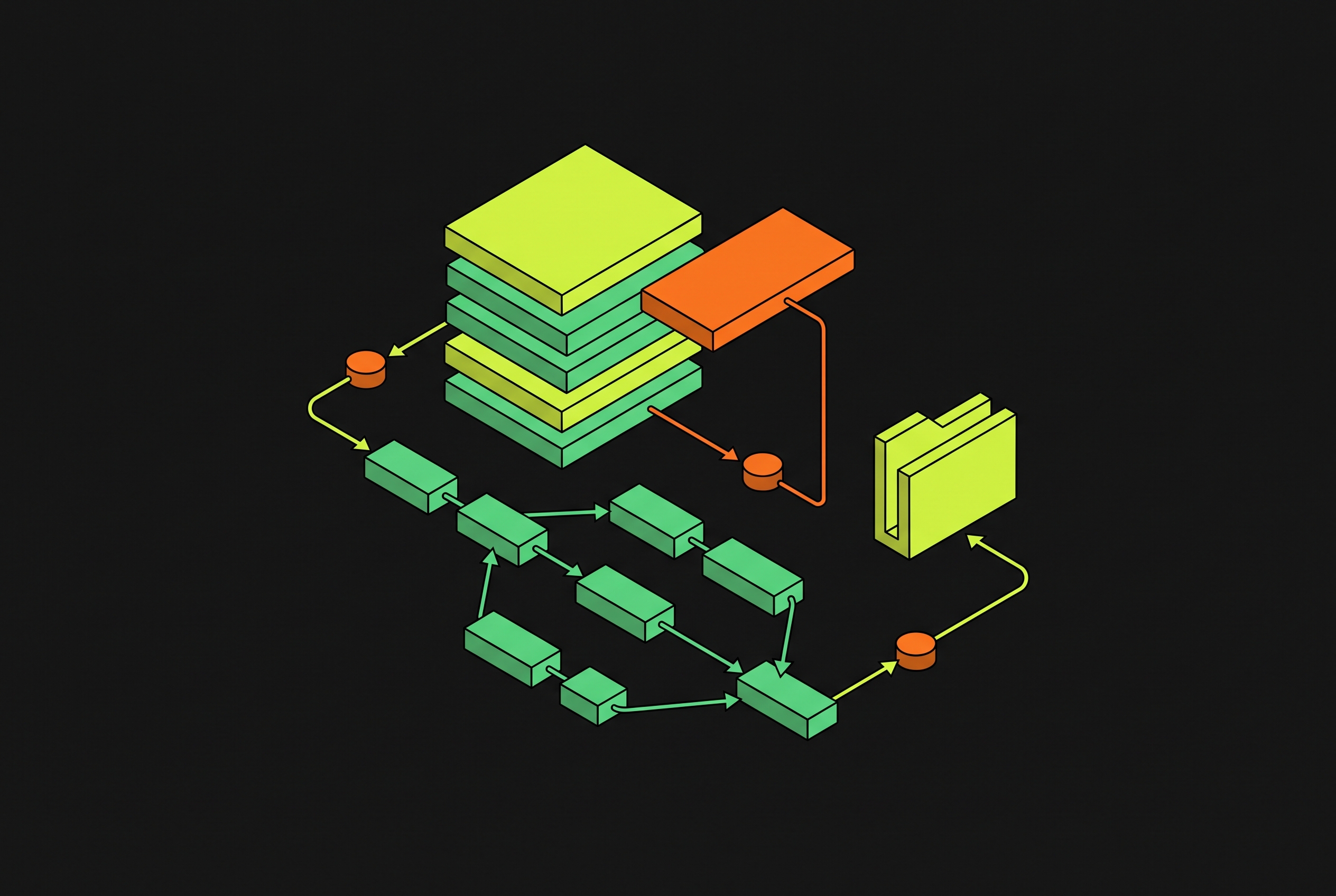
Prompt management is a software engineering problem. Prompts that shape production behavior need the same versioning, testing, governance, and lifecycle discipline as code and dependencies. Treating them as informal text leads to familiar engineering failures, which teams must fix by controlling how a proposed change reaches production and monitoring it after release.
Why prompts stopped being text and started being production artifacts
A Notion doc can hold a prompt, but it cannot by itself establish which version a service used, who approved it, or how to restore its predecessor. As organizations deploy hundreds of prompts across services and agents, Slack threads are just as poor a way to control changes. This leads to silent regressions, prompts with no known owner, and no rollback path. Production-critical behavior depends on artifacts that are handled outside the controls applied to production-critical code.
The PROMPT-SE 2026 workshop research agenda defines a “prompt artifact” as “the set of instructions and contextual elements deliberately assembled, stored, or reused to support an LM-based SE task”. That definition moves the object of engineering beyond a text string. Context, examples, constraints, templates, and interaction rules belong to the material being managed. Once that assembled material is treated as an artifact, the questions change from whether its wording sounds right to whether its behavior can be evaluated and traced. Versioning, evaluation, traceability, governance, and technical debt become properties of the system.
What "prompt debt" actually looks like when it accumulates
Prompt debt builds up in the same way as technical debt. It remains difficult to see until it becomes expensive, by which point several dependents may share the underlying problem. An untracked edit illustrates the mechanism. A prompt changes to fix a quality issue, but no one records what changed or why. When output changes weeks later, the team cannot tell whether the earlier fix caused it.
Deployment coupling creates a different kind of debt. When prompts are embedded in application code, a text change requires a full redeploy, slowing iteration and bundling prompt experiments with unrelated code changes. That bundle contaminates the signal needed to judge the experiment. Environment drift makes the evidence weaker still, because the prompt validated in staging may differ from the one running in production. Without a canonical registry, a successful test can describe the wrong artifact.
As teams and agents start sharing prompts, losing track of who owns them makes these technical failures worse. If no one knows who can authorize a change, either changes stall or anyone changes anything. In healthcare and finance, the absence of documented control also becomes a compliance problem. ISO 42001 and SOC 2 require documented change control and audit trails, while the voluntary NIST AI RMF strongly emphasizes auditability and documentation. The dependency-management analogy is precise here, because an unversioned dependency with no lockfile, changelog, or owner would be rejected at code review, yet unversioned prompts are routinely accepted.
The five engineering concerns that a mature prompt discipline must address
The PROMPT-SE 2026 workshop research agenda identifies five areas for applying software engineering methods to prompts. Prompt artifacts and standardization concern schemas and contracts, defining what an artifact contains, how it is identified, and which metadata travels with it. Evaluation and benchmarking concern test suites, defining a passing result and the checks applied to changes. Lifecycle integration covers CI/CD and how prompts move through development, staging, and production. These areas connect the identity of an artifact to evidence about its quality and the conditions of its release.
The remaining areas address the people and policies that control that movement. Human-AI collaboration and skills cover roles and review, including who owns a prompt, who can approve changes, and how pull-request workflows work. Governance, privacy, and technical debt concern model-selection policies, data-handling constraints, and the accumulated cost of shortcuts. The research agenda argues that this approach makes regression testing and prompt debt detection part of normal work, with evaluation that checks artifact quality, outcome quality, and process quality.
Version control for prompts: what Git-style discipline actually requires
Git-style version control means that every prompt change has an identifier, a diff, and an author. Those records make iterations comparable and allow an output to be associated with the version that produced it. That association matters when an audit asks why a system said what it said. Keeping several copies of a prompt is not equivalent, because a collection of alternatives does not establish the history of a deployed artifact. The useful unit is a recorded change that can be traced through release and use.
Runtime resolution separates that release from an application deployment. Instead of reading a prompt embedded in application code, the service fetches the canonical version from a registry at request time. The prompt can then be changed, tested, and promoted without changing the codebase or triggering a redeploy. This separation addresses deployment coupling, but it does not remove the need for release controls.
PromptHub provides branch, commit, and merge operations, a REST API for runtime retrieval, and CI/CD guardrails that can block low-quality deployments. Braintrust links versioning to environment-based deployment so prompts move through development, staging, and production, while a prompt that fails staging evaluation is blocked from reaching production automatically. Confident AI combines version-control-based prompt management with evaluation-first observability and approval workflows before promotion. Without role-based control over who can promote a prompt, version history records what happened but does not control what can happen.
Testing prompts the way you test code: evaluation pipelines and quality gates
Version history without automated evaluation is an archive. It establishes what changed without establishing whether the change improved behavior. Evaluation supplies that missing evidence by testing a candidate before promotion and watching its performance after release. The system retains not just a sequence of edits, but a basis for deciding which edits may reach production.
The evaluation pipeline begins during development, with unit-test-style checks on every commit that can run in milliseconds. A check might ask whether output contains a phone number when it should not. At the other end, production monitoring tracks quality by prompt version over live traffic. A narrow check and a live quality signal answer different questions. A serious pipeline connects them.
Braintrust has a GitHub Action that runs evaluations when a prompt changes in a pull request, so teams review prompts as part of the code-review process. Its Topics feature classifies production traces by intent, sentiment, and recurring issue, making regressions visible in traffic patterns without a support ticket. Promptfoo provides an open-source CLI for CI/CD testing and red teaming, with the ability to block deployments that fail quality thresholds. These tools make testing a condition of change within development and release workflows.
LLM-as-a-judge scores are useful only when they correlate with human judgment, or teams can optimize for high scores and still produce poor outputs. For brand voice and content quality, semantic similarity alone cannot show that output is ready. Automated metrics need human audit scorecards with verified inter-rater agreement so the gate is calibrated against a meaningful standard. Adversarial multi-model review is another architectural choice, used by Letterwrite’s writing kernel to have models critique and vote on output, catching failures that a single model’s self-evaluation misses because models have different blind spots.
Governance structures: ownership, approval workflows, and audit trails
Evaluation checks a change against quality requirements but does not establish who has authority to release it. Prompt governance supplies defined ownership, mandatory review before production promotion, an immutable audit trail, and a rollback path that does not require an emergency deployment. A passing score cannot substitute for approval, just as approval cannot substitute for a passing score. Both belong in the release process.
For systems that affect medical triage or loan eligibility, the record must make every production version defensible. The distinction between binding requirements and voluntary guidance remains important, but neither is satisfied by an undocumented editing convention. Output provenance extends the record beyond the prompt itself to the model and model version that produced the result. The 2024 EU Artificial Intelligence Act adds pressure through its AI-output watermarking requirement, entering into force on 2 August 2026, with a grace period to 2 December 2026 for systems already on the market. Prompt governance and output provenance therefore need to be designed together.
OpenAI announced its acquisition of Promptfoo in early 2026, while Humanloop shut down its platform following an acqui-hire by Anthropic. These changes are a reason to verify a tool’s current state before building governance processes around it. Software can enforce who has permission to approve changes and keep records of those changes, but it cannot decide which team should own a shared prompt or which review policy fits its use. Governance is a process.
What a prompt management stack looks like when it is wired into a real development workflow
A production-grade stack connects four layers. A central registry stores prompts as versioned artifacts with metadata, and a runtime resolver retrieves the correct version at inference time without a redeploy. An evaluation pipeline runs CI/CD quality gates on every commit and blocks promotion if the change fails. An observability layer tracks quality, latency, cost, and token consumption by prompt version in production. Together, these layers connect the artifact being changed to the behavior being measured.
The developer workflow follows that connection from proposal to release. Changes are committed to branches, evaluated automatically on merge, and reviewed and approved by designated owners. They move through development, staging, and production only after passing defined gates, then remain under continuous monitoring so regressions can surface before users report them. CLI, API, and SDK access make this work part of the normal development cycle. Without that access, a separate interface can become a workflow engineers route around.
The registry must also preserve the relationship between a prompt and the model against which it was evaluated. The same prompts can produce different outputs across model families and fine-tuned variants within a family. A prompt that passes on one model may fail on another, so a prompt version alone does not describe the tested configuration. Letterwrite’s writing kernel makes this multi-model principle concrete through adversarial drafting, critique, and convergence, treating the ensemble as configurable infrastructure beneath versioned prompts. Its API-accessible architecture places voice fidelity and output quality in the harness and can follow the same versioning, CI/CD, and audit discipline as other system components.
The managed object includes the instructions, their release history, their evaluation evidence, and the model relationship needed to interpret that evidence. Its lifecycle runs through the same development workflow that controls other production dependencies. Moving prompt management from a shared Google Doc, a Slack thread, or hardcoded application source into the terminal puts it alongside everything else.
Sources
- From Prompting to Engineering: A Research Agenda for Prompt Engineering in Software Engineering · Pith
- PromptDebt: A Comprehensive Study of Technical Debt Across LLM Projects
- Promptware Engineering: Software Engineering for Prompt-Enabled Systems
- Reporting LLM Prompting in Automated Software Engineering: A Guideline Based on Current Practices and Expectations