

Content Pipeline Design for Engineering-Led Teams
Build content pipelines with specialized agents and validation gates, not prompt refinement alone.
October 16, 2026
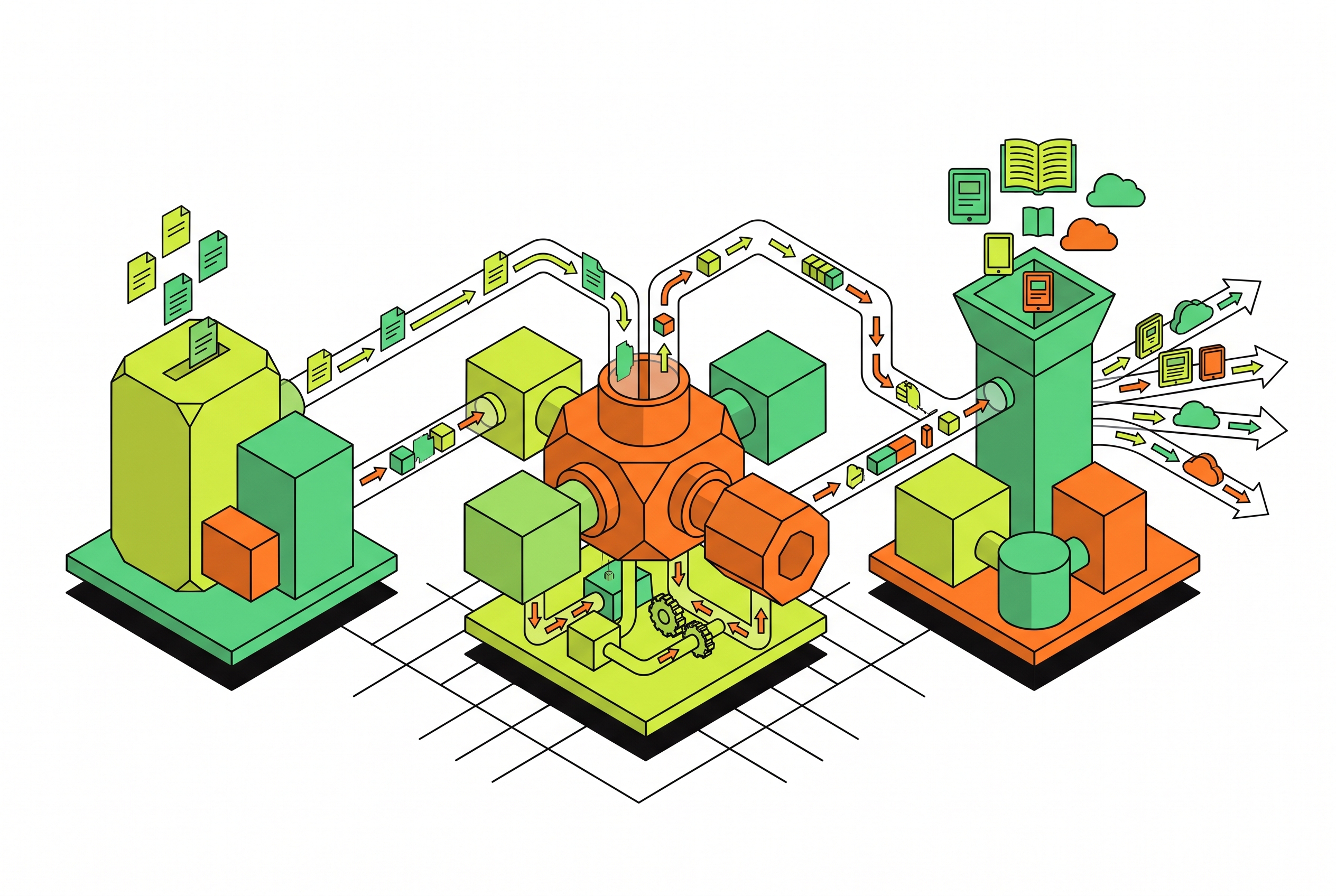
Content production fails at scale for the same reason software delivery fails without a build pipeline: the work happens in one undifferentiated pass, with no validation, no contracts, and no way to know what went wrong. The fix is not a better prompt. It is treating content as a system with specialized stages, automated gates, and measurable outputs, the way engineering teams already treat the rest of their stack.
Why prompt-and-publish fails at production scale
A large language model is a zero-shot generalist. Without explicit voice training and downstream enforcement, its output defaults to generic web-English regardless of how carefully the prompt is written. That is not a defect in the model. A prompt can push against that average, but it cannot replace a deterministic layer that checks whether the push succeeded.
The absence of that layer compounds every other problem. Brand voice drifts across runs because nothing measures it. Fabricated claims pass through unchecked because nothing verifies them. Content that fails editorial review or platform quality standards ships anyway because there is no gate that blocks deployment. Each of these is a validation failure, and validation is exactly what a prompt cannot provide. Adding more instructions to a single prompt does not substitute for a component whose entire job is to test output against criteria and reject what fails.
The failure is therefore structural, not a prompt quality problem. A team that keeps refining prompts is optimizing the wrong variable. The right frame is that content production is a software delivery problem, and the practices that make software reliable, specialized components, handoff contracts, automated QA gates, apply here with the same force.
What a production-grade content pipeline looks like, stage by stage
A production content pipeline assigns each major task to a specialized agent with a single responsibility and a defined handoff contract. The alternative, one model doing everything in a single pass, is the architectural equivalent of a sprawling script with no functions. The representative sequential pattern is one agent for collecting and structuring source material, one for deciding what the piece argues and how, one for producing the draft, one for checking search intent and format requirements, and one for adapting the approved piece for distribution channels. Each agent is scoped to one function, and its output is validated before the next stage consumes it. The Research Scout gathers and structures source material. The Content Strategist decides what the piece argues and how. The SEO Review checks alignment with search intent and format requirements. None of these steps requires the next to trust the previous blindly. The handoff contract specifies what valid input looks like.
The evaluator-optimizer loop is the quality pattern that makes this work under the surface. One agent generates output, a second evaluates it against criteria and returns feedback, and the generator iterates until the evaluator is satisfied. What is new is encoding the relationship as a loop with an exit condition.
It is worth being precise about what the model does in this architecture. LLM inference is one step. The deterministic code layers handle data ingestion, prompt templating, post-processing, and automated QA. The model is not the pipeline any more than the compiler is the build system. And for pipelines where content types or formats vary, an orchestrator-workers pattern lets a central agent break down tasks and delegate at runtime rather than following a fixed sequence.
How model choice and role specialization affect output quality across the pipeline
Different stages have different performance requirements, and running one model everywhere is the same kind of mistake as using one tool for every build step. For developer marketing, some models hold structured voice across long technical pages and follow format rules reliably. Others are faster and better suited for clustering signals, classifying intent, or producing short summaries. The right choice is per workflow, not per vendor preference.
Adversarial multi-model review changes this calculation further. When a draft passes through a critique agent on a different model, that model's distinct training distribution catches patterns the first one normalized. Shredding output across models is a structural fix for the homogenization problem, not a workaround. If both models are the same, the evaluator finds the same things acceptable that the generator produced, and the loop degenerates into self-confirmation.
Letterwrite's writing kernels operationalize this directly. Adversarial multi-model systems draft, critique, and vote on output line by line, running recursion until the output converges. Seven passes to convergence is the average number of recursions, not a latency bug. The number matters because it tells a team what to expect from the pipeline: convergence is a property of the architecture, and the architecture takes as many passes as the quality bar demands.
Voice fidelity as an engineering problem, not a style guide problem
Voice fidelity at scale requires treating brand voice as a specification the pipeline enforces, not as guidance a human checks after the fact. The failure mode has a name: the flattening effect. The damage is cumulative and quiet.
Narrative drift is a pipeline-level problem with the same root. When a brand's persona diverges across models because of differing training data and weighting, no amount of per-prompt instruction fixes it. The corpus and enforcement layer have to be designed in. The fix is a three-layer approach. First, document voice as behavioral rules and explicit vocabulary lists, not vague adjectives. Second, build a training corpus of existing on-brand content large enough to show the model what the voice looks like. Third, operationalize enforcement as an automated gate, not a post-hoc review step.
The choice between retrieval and fine-tuning follows from constraints, not preference. RAG over a brand guide returns semantically on-brand samples, but if you don't add explicit voice descriptor tagging to the retrieval corpus, it won't catch tone drift on new content categories. Letterwrite's post-trainability on a team's own corpus is the structural answer to the flattening problem: output converges on the team's specific voice because the kernel is trained on what the team has already written.
The evidence that this approach works is concrete. With a populated knowledge base, a voice-aware scriptwriter agent got first-round approval without edits for 78 percent of outputs across five B2B brands. None were rejected outright.
Watermarking and AI detection as pipeline engineering concerns, not legal afterthoughts
EU AI Act Article 50, applicable from August 2, 2026, and the EU Code of Practice on Transparency of AI-Generated Content make watermark preservation a pipeline engineering concern. If you design post-processing without thinking about watermark integrity, you create compliance risk you may not see until it is too late. The timeline is not abstract. The applicability date is fixed.
Anthropic said future Claude models will generate text containing a watermark, and Anthropic is among roughly 190 signatories to the Code of Practice. The mechanism is statistical, not visible. The same mechanism that makes fingerprinting useful for ownership also makes it a target for pipeline post-processing that inadvertently strips it.
Detection without verified watermarks remains unreliable. The engineering implication is direct: pipelines that apply heavy rewriting or style normalization as a final step need deliberate watermark-preservation design. This is not optional hardening under the EU regime. The architecture that improves prose quality through iteration also has the potential to affect statistical signals embedded by upstream models. That is a design consideration all such pipelines face, not a defect in any particular implementation.
Why adversarial vulnerability in multi-agent pipelines is an architectural property, not a model problem
In a multi-agent content pipeline, once adversarial content is accepted at one stage, it propagates as trusted input to every downstream stage. The vulnerability does not. The missing security primitive is boundary verification: explicit validation of data as it crosses inter-agent boundaries, covering content, identity, execution intent, and state integrity. Three distinct boundary classes lack verification in typical designs. Content boundaries allow retrieved content to override agent directives without sanitization. Identity boundaries infer agent identity from routing position rather than verifiable credentials. When you delegate, downstream agents don't have to adhere to the prescribed execution plan. The attack surfaces that follow are content injection, agent impersonation, plan deviation, and memory poisoning, all from the same structural gap.
For content pipelines specifically, the most relevant threat is ingestion of external sources. Research on agentic adversarial rewriting against black-box NLP pipelines shows a legacy system relying on static lexical retrieval exhibits near-total vulnerability, a 97.02 percent evasion rate, while modern LLM-based pipelines show meaningful but lower evasion rates. For content teams, the practical implication is to treat boundary verification between agents as a necessary engineering control, the way input sanitization is a necessary control in any web application.
Style enforcement as a CI gate, not a final review
The software delivery analogy pays off most directly here. Treating writing quality as a CI gate rather than an editorial review step is what makes a content pipeline deterministic. Outputs either pass a measurable threshold and ship, or they fail and return to the previous stage. The system behaves the same way every time.
A layered quality pipeline applies automated metrics, BLEU, ROUGE, BERTScore, for lexical and semantic similarity, plus LLM-as-judge evaluation for subjective dimensions like coherence and tone. CI gates block deployment when quality thresholds drop below the defined level. Test suite design follows software testing conventions: cases covering normal inputs, edge cases, and adversarial inputs per quality dimension. Adversarial test case generation for hallucinations, contradictions, prompt injections, and inappropriate content can be automated with tools like Giskard, Apache 2.0 licensed, without manual authoring of every case.
Style contracts are version-controlled artifacts. The voice rules, vocabulary lists, and prohibited patterns ship with the pipeline and are updated the same way configuration is updated, not managed separately in a document that drifts from actual enforcement. Letterwrite's adversarial councils and recursive convergence implement this at the writing kernel level. The framing difference is cultural, not technical.
Developer toolchain integration: CLI, APIs, and writing harnesses that belong in the terminal
The difference between an AI writing tool a human uses in a browser and one that another program can invoke reliably is what allows content generation to move into scheduled jobs, repository checks, and CI pipelines. The API surface is not a convenience feature. It is what makes the system composable.
Leading CLI-to-pipeline patterns in 2026 map to distinct use cases. Claude Code handles complex interactive agentic coding tasks. Gemini CLI targets structured headless automation, including JSON and JSONL output and CI workflows. Cline CLI is built for headless scripts and pipelines via stdin and non-interactive operation. Claude Code skills, SKILL.md files each in their own directory, encode multi-step workflows that turn repeated tasks like writing posts, running QA audits, and deploying content into reusable, version-controlled commands. Content production becomes repeatable in the same way build scripts make compilation repeatable.
The production-grade developer marketing pipeline pattern is five stages with a strict gate at each. The voice prompt ships with real writing samples from the team plus explicit rules about what marketing language to avoid. Letterwrite's API-first design, every capability reachable by an agent through an API, not only by a person through a UI, is what makes writing kernels composable into existing engineering stacks. The pipeline is assembled from pieces, not purchased as a bundle.
What engineering-led teams actually own when they build content as infrastructure
When content production is designed as infrastructure, with deterministic validation, enforceable style contracts, boundary-verified agent handoffs, and a CI-gated delivery path, the team owns a system they can audit and improve. That is different in kind from owning a process that depends on individual prompt craft or editorial judgment varying by author. The gain is instrumentability. A pipeline with measurable quality gates shows you where output fails, which stage introduces drift, and which content types need more recursion. Voice becomes a versioned artifact: the brand corpus and style contracts are checked into version control, diffable, and deployable. Voice changes are intentional and traceable, not emergent and invisible.
AI answer engines are becoming the front door to content discovery. To be cited in a generated answer, your content has to be genuinely accurate, specific, and machine-readable. Instrument the pipeline, measure output quality against defined thresholds, and change the system on evidence. What this does not require is a separate content operations team, a bespoke CMS, or a prompt library managed in a shared document. The toolchain is the terminal, the API, and the version-controlled corpus.
Sources
- [2608.00718] Adversarial Attacks in Multi-Agent LLM Pipelines: Unveiling Structural Vulnerabilities in Agentic AI Architectures
- Agentic Adversarial Rewriting Exposes Architectural Vulnerabilities in Black-Box NLP Pipelines
- Adversarial Attacks in Multi-Agent LLM Pipelines: Unveiling Structural Vulnerabilities in Agentic AI Architectures
- Watermarking in Generative AI